
Feature
Hold and Win
- Trigger
- A combination of 6 special and/or Jackpot symbols
- Effect
- The Jackpot Game opens with 3 respins and every special and Jackpot symbol locks in place.
Up to 5,000x the bet per round
The Hold and Win round, the collector that clears the reels, multipliers running to 100x and four fixed jackpots that start at 500x for two symbols.
Feature
Up to 5,000x the bet per round
Feature
The whole board in one payout
Feature
1x, 2x, 3x, 4x, 5x, 10x, 25x, 50x, 75x and 100x
Feature
500x, 1,000x, 2,000x and 3,000x
Feature
80x the total bet
Serengeti Sunrise features and bonuses
Ten lines that frame every mechanic on this page.
Multipliers of the total bet for five of a kind, plus what each symbol does on the board.
| Symbol | Role | Behaviour |
|---|---|---|
| A | 4x | Best of the royals |
| Cheetah | 12.5x | The middle of the premium group |
| Elephant | 50x | Top of the regular paytable and the symbol you want filling a line |
| J | 2x | The floor of the paytable |
| Jackpot symbol | 500x to 3,000x | Two of them award the Mini, five award the Grand |
| K | 3x | Filler win that slows the bleed |
| Q | 2.5x | Filler win |
| Rhino | 25x | Second premium, common enough to keep a session moving |
| Special symbol | 1x to 100x | Pays outside the paylines and feeds the collector; 200 credits at a total bet of 20 |
| Wild lion | 50x | Substitutes for all regular symbols and lands stacked four symbols high |
| Zebra | 5x | Entry-level premium, the bridge to the royals |
Values on the demo scale at a total bet of 20, with the bet multiplier for five of a kind alongside.
| Combination | Configuration | Value |
|---|---|---|
| A | 4x for five | 80 / 60 / 50 |
| Cheetah | 12.5x for five | 250 / 150 / 80 |
| Elephant | 50x for five | 1,000 / 500 / 200 |
| J | 2x for five | 40 / 30 / 20 |
| K | 3x for five | 60 / 50 / 40 |
| Q | 2.5x for five | 50 / 40 / 30 |
| Rhino | 25x for five | 500 / 200 / 100 |
| Wild lion | 50x for five | 1,000 / 500 / 200 |
| Zebra | 5x for five | 100 / 80 / 60 |
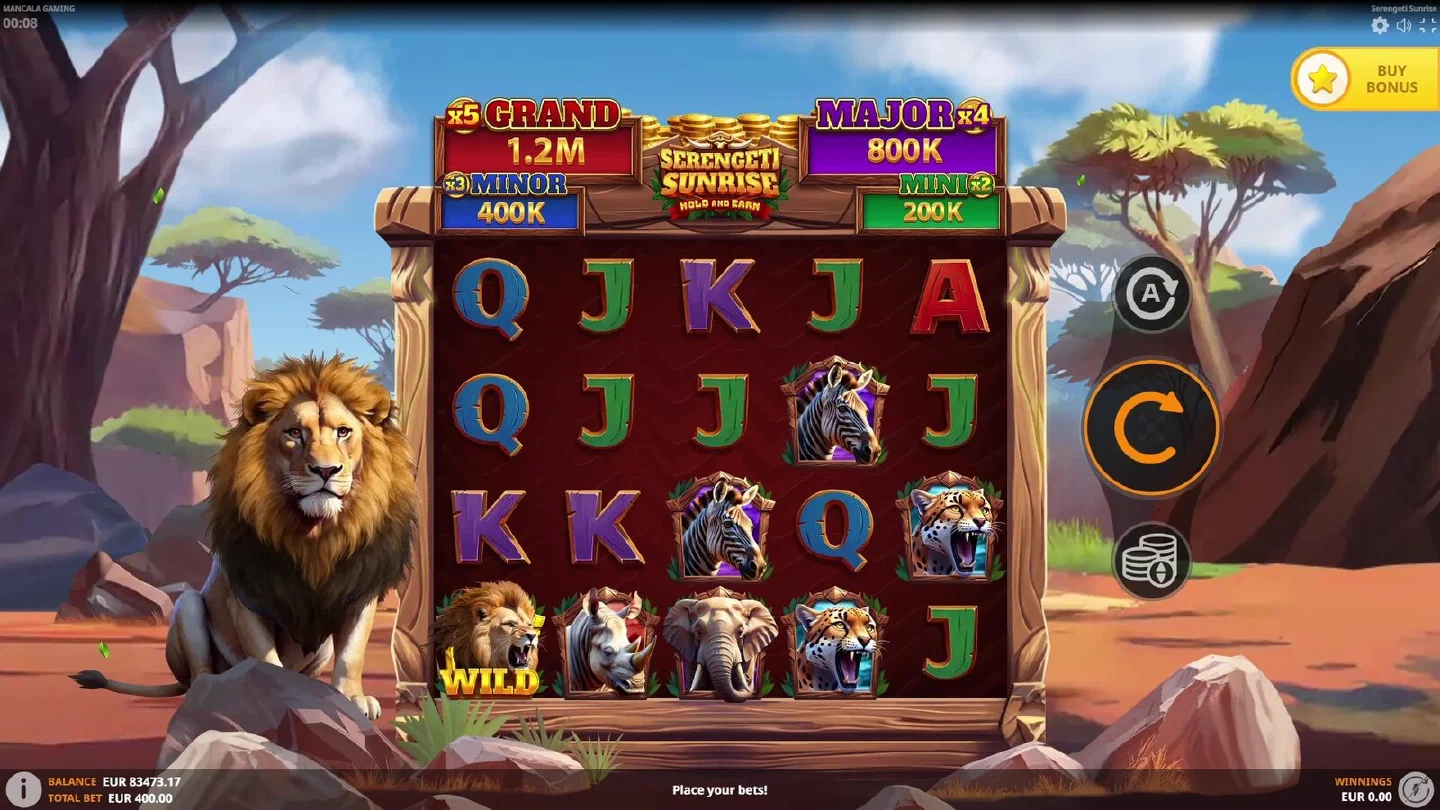
The bonus is called Hold and Win, and the game logo signs it Hold and Earn. Same mode, two names, and the only one that matters is the condition that opens it: a combination of 6 special and/or Jackpot symbols. No scatter count to memorise, no reel restriction, no second trigger buried in the rules.
That last line contains the best-case scenario. A completely full board means every position has been carrying value, the collector has been sweeping it up, and the 5,000x round cap is the only thing left above you.
People search this game for free spins, and this round is the answer. Six symbols open it, the counter starts at 3 and every new symbol sends it back to 3: extra spins that cost no additional bet, with the board frozen in your favour while they run. What you lose compared to a classic free spins round is the paylines. What you gain is a board where only the valuable symbols are live.
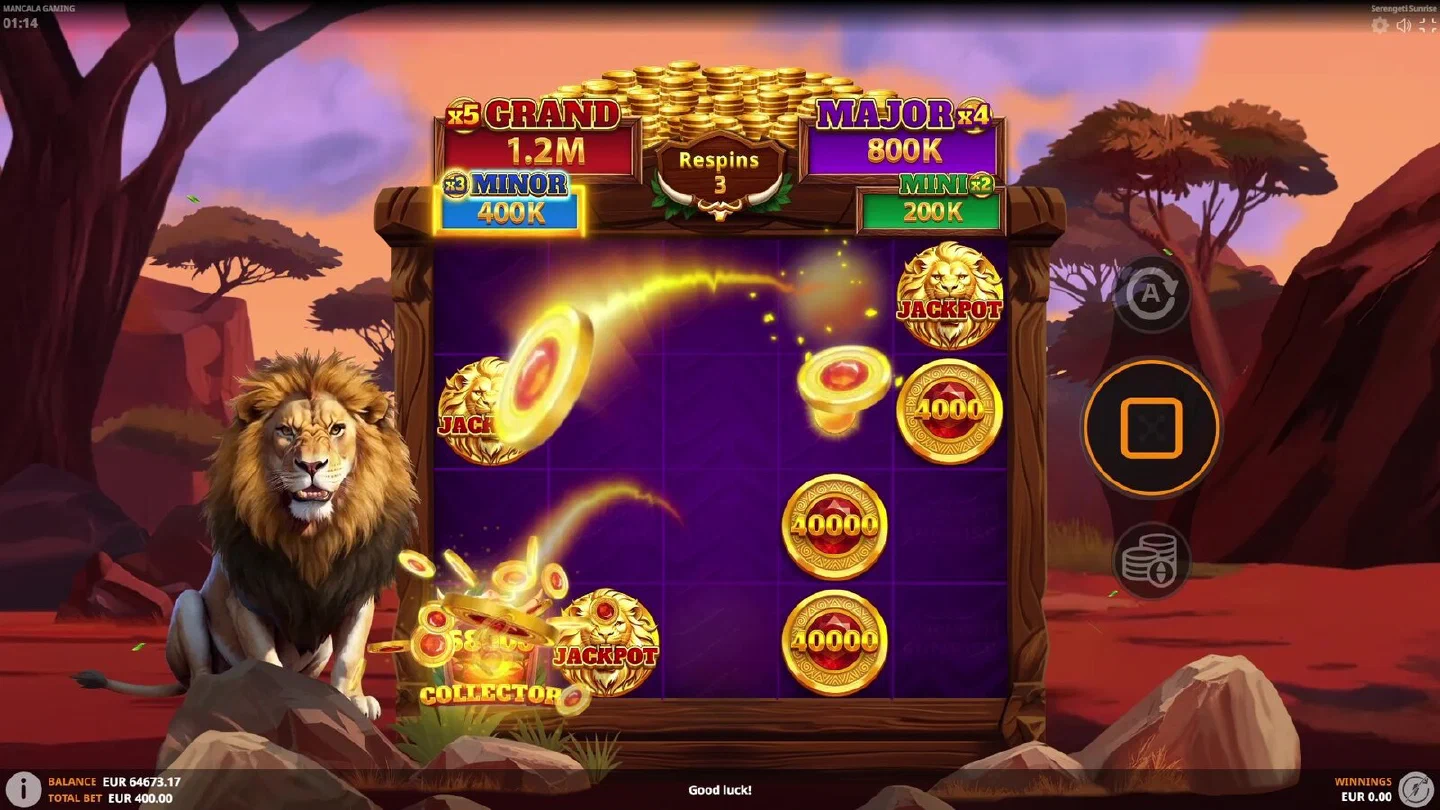
There is a rhythm to it that the demo teaches faster than any description. Early symbols are worth more than late ones, because each one buys three fresh chances at the next. A round that lands two symbols in the first respin is usually a long round. The how to play page covers the controls, and the demo lets you watch it happen for nothing.
Judge the collector on one criterion: whether a respin round can still receive symbols once the board is crowded. On a 5x4 grid there are twenty positions, and every locked symbol takes one of them out of circulation. The collector is the piece that hands them back.
In the base game it does the obvious thing: it gathers the winnings of every special symbol on screen and pays them out as one sum. Nice, tidy, occasionally lucrative. Three special symbols at the standard value of 200 credits at a total bet of 20 is 600 credits on a spin that cost you 20.
In the bonus round it does something better. It gathers those payouts and then removes the symbols from the board. Without that step a respin round slowly chokes: positions fill up, free spaces run out and the counter has nowhere to be reset from. Here the collector reopens the spaces, so the board can keep receiving symbols, and every one of them resets the counter to 3 again. That recycling loop is the only realistic path from a standard round to the 5,000x ceiling.
The values it collects are not uniform. Special symbols carry multipliers of 1x, 2x, 3x, 4x, 5x, 10x, 25x, 50x, 75x and 100x, and the standard value is 200 credits at a total bet of 20, which is 10x your stake. A single 100x symbol on that stake is worth 2,000 credits on its own. Put a 100x, a 75x and a 50x on the board together and the collector is sweeping 225x your bet in one motion, before the jackpots are even in the conversation.
The session-level consequence is covered on the strategy page : rounds in this game are worth waiting for precisely because they compound.
| Jackpot | Jackpot symbols | Bet multiplier | At a total bet of 20 |
|---|---|---|---|
| Mini | 2 | 500x | 10,000 |
| Minor | 3 | 1,000x | 20,000 |
| Major | 4 | 2,000x | 40,000 |
| Grand | 5 | 3,000x | 60,000 |
These are fixed jackpots, not progressive ones, and the distinction has a practical test: a progressive prize depends on what other players have staked, a fixed one depends only on what you staked. Here the prize is a plain multiple of your own bet, awarded by the number of Jackpot symbols on the board. Which means the Mini at a stake of 1,800 is worth 900,000 while the Grand at a stake of 20 is 60,000. Your stake choice sets the entire ladder.
Look at the bottom rung again. Two Jackpot symbols pay 500x. That is ten times what five elephants return on the best line in the base game, for a condition that is far easier to meet inside a round you have already entered: two symbols anywhere on the grid against five in the right order on one of 40 lines.
Then set the top of the ladder against the top of the round. The Grand pays 3,000x, while the rules cap a round at 5,000x the bet, Gamble winnings included. Two thousand times your stake sits above the biggest jackpot in the game, reachable only through the special symbol multipliers and the collector adding them together. A round that awards the Grand is not the end of the story; it is a very good round with room left on top.
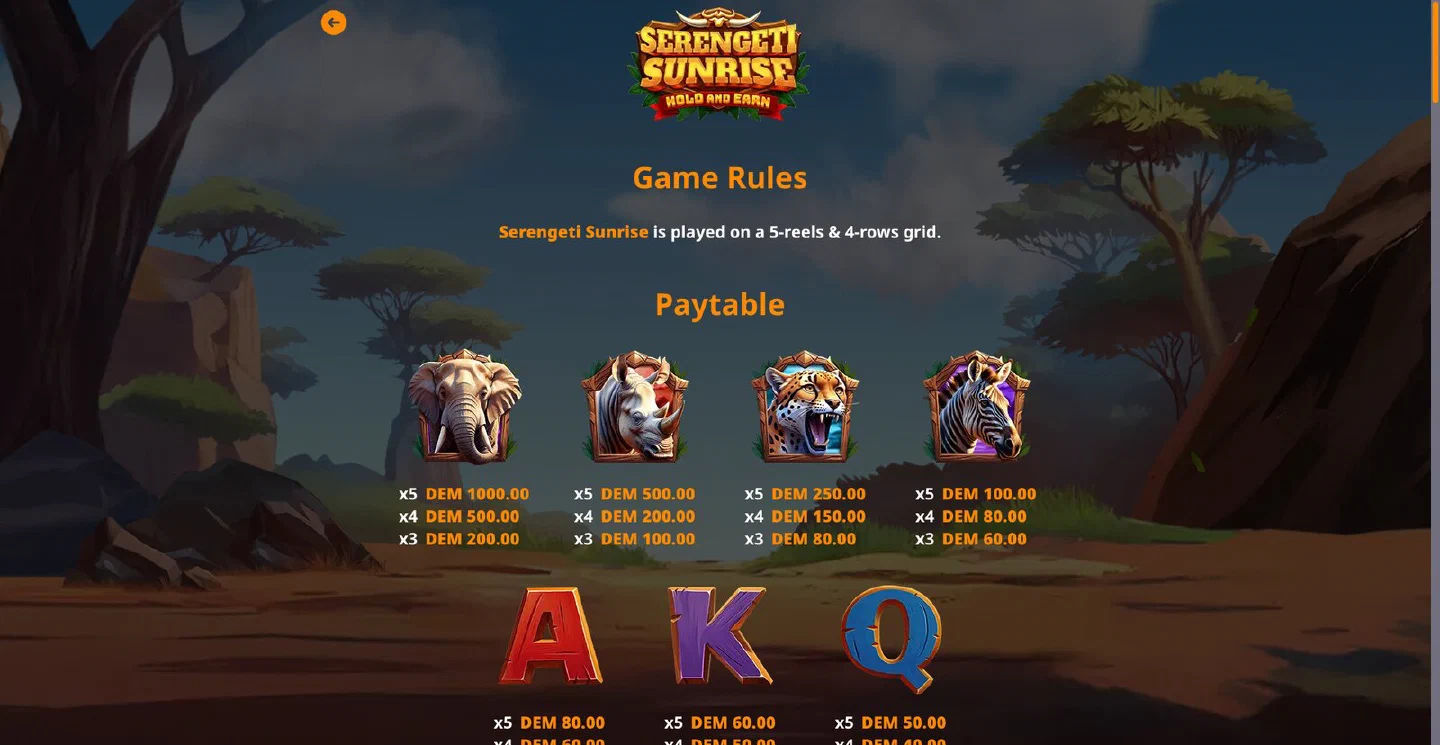
This is the page that owns the full table, so here it is in one piece, on the demo scale at a total bet of 20, with the five-of-a-kind multiplier of your bet in the last column.
| Symbol | Five | Four | Three | Five of a kind as a multiple |
|---|---|---|---|---|
| Elephant | 1,000 | 500 | 200 | 50x |
| Wild lion | 1,000 | 500 | 200 | 50x |
| Rhino | 500 | 200 | 100 | 25x |
| Cheetah | 250 | 150 | 80 | 12.5x |
| Zebra | 100 | 80 | 60 | 5x |
| A | 80 | 60 | 50 | 4x |
| K | 60 | 50 | 40 | 3x |
| Q | 50 | 40 | 30 | 2.5x |
| J | 40 | 30 | 20 | 2x |
Read the columns right to left and the game explains itself. The three-symbol column is where the frequency lives: three elephants pay 200 credits, three rhinos 100, three jacks 20. Those small returns are most of the 15.99% of spins that land a win, and they are the reason a bankroll lasts long enough to reach a bonus round. The four-symbol column is the one that makes an evening feel decent, with 500 for four elephants and 200 for four rhinos. Only then does the five-symbol column matter, and by itself it tells you the ceiling of the base game and nothing about its pulse.
Make one comparison across the whole table before you leave it. The gap between the top row and the bottom is 25-fold for five of a kind, 1,000 credits against 40, but at three symbols it narrows to 10-fold, 200 against 20. The paytable is steepest exactly where the wins are rarest, which is the arithmetic behind a 4-of-5 volatility rating.
The wild lion is worth its own paragraph. It substitutes for all regular symbols and it arrives stacked four symbols high, which on a four-row grid means a full reel of wilds. A stacked lion on reel three can complete combinations across a large slice of the 40 lines at once, and since it also pays 50x for five of a kind in its own right, it is both the connector and a premium symbol.
The special symbols and the Jackpot symbols sit entirely outside this system. They ignore paylines, pay wherever they land, and they are the only thing that matters once the respin round starts. That two-tier design is why the base game feels calm and the bonus feels loud.
Taken separately each mechanic is ordinary. The interesting part is the way they interact, so here is a single round assembled from the rules instead of from imagination.
A combination of 6 special symbols lands and the Jackpot Game opens with 3 respins. Say four of those six carry the standard value, 200 credits at a total bet of 20, and two carry higher multipliers, one at 25x and one at 50x. Before a single respin has been played the board is holding 40x of standard value plus 75x from the two bigger symbols.
The first respin adds a symbol. The counter goes back to 3. The collector arrives and sweeps what is on the board, then clears those positions, which is the mechanic that decides everything from here: the board is no longer crowded, so the next respin has somewhere to put a new symbol, and every new symbol buys three more chances.
Now add a Jackpot symbol or two. Two of them award the Mini at 500x, which on that stake is 10,000 credits, and they stay on the board because special and Jackpot symbols both stick. Three would make it the Minor at 1,000x. The jackpot is not an alternative to the collected values, it is added on top of them.
The round ends in one of two ways: the counter reaches zero, or the reels fill completely. If it fills, the collector has been recycling the whole way, and the only limit left is the 5,000x round cap. That is 100,000 credits at a stake of 20 and 9,000,000 at the maximum of 1,800.
None of that is a prediction, and most rounds end far earlier. What the walk-through shows is where the value actually comes from: not from one lucky symbol but from a loop that keeps reopening. The maths page puts the same structure into numbers at four stake levels, and the strategy page turns it into a session plan.
There is one purchase option, priced at 80x the total bet, and no variants to weigh up. On a stake of 20 it costs 1,600 credits, at 100 it is 8,000, and at the maximum of 1,800 it is 144,000. The price being a multiple is the useful part: the decision is identical at every level, and you can size it against your own bankroll instead of against a fixed price tag.
Is it worth it? That depends entirely on what you are buying. Eighty times your bet is 80 base spins you skip, and a purchased round has the same content as a triggered one: three respins, a counter that resets, sticky symbols, a collector and four jackpots from 500x up. A round that lands the Mini alone pays 500x against the 80x you spent. A round that stalls after three respins pays a fraction of it.
The discipline that works is arithmetic, not instinct. Decide how many buys the session gets before the first one, say five at a stake of 20 for a budget of 8,000 credits, and stop at that number regardless of how the run is going. The thing that empties a bankroll in this game is not the price of the buy, it is buy number six after five misses.
If you would rather earn the round than buy it, the trigger is the same six symbols and the base game keeps the jackpots on the ladder the whole time. Everything else about the game is on the Serengeti Sunrise hub , and the controls are explained on the how to play page .
18+. The features of Serengeti Sunrise are entertainment, not an income plan. Decide your limit before the first spin with the responsible gambling page .