
The maths of Serengeti Sunrise, step by step
One published RTP, one hit rate, one ceiling, and four stakes to measure them against.
A 95% RTP: what it means in practice#
Serengeti Sunrise ships with a 95% RTP. Return to player is the share of all money staked that the game pays back across millions of rounds, measured over the whole population of spins, not over your afternoon. Each room runs the configuration it has licensed, so the game info panel inside the casino is what counts before you raise the bet.
Ninety-five per cent is a deliberate choice, not an accident. A slot carrying four fixed jackpots and a respin round with multipliers to 100x has to fund those prizes from somewhere, and the funding comes out of the base game’s return. What you are buying at 95% is a shot at a 500x payout from two symbols, which is an unusually short ladder.
The useful way to hold the number is as a rate, not a promise. Over 1,000 spins at a total bet of 20 you stake 20,000 credits, and 95% of that is 19,000 across the long run. Your own thousand spins will land nowhere near that figure in either direction, because the payback is concentrated: most of it lives in rounds that only 15.99% of spins even start to build toward. That is the whole character of the game in one sentence.
A published return figure is only worth the machinery behind it, and behind this one sit random number generators that Mancala Gaming has had independently tested and certified. What that buys you as a reader is a spin that is genuinely drawn rather than steered: the sequence carries no memory, and no bet pattern shifts the next result toward or away from the 95%. The studio side of it is covered on the Mancala Gaming page .
Volatility and hit rate: how a session feels#
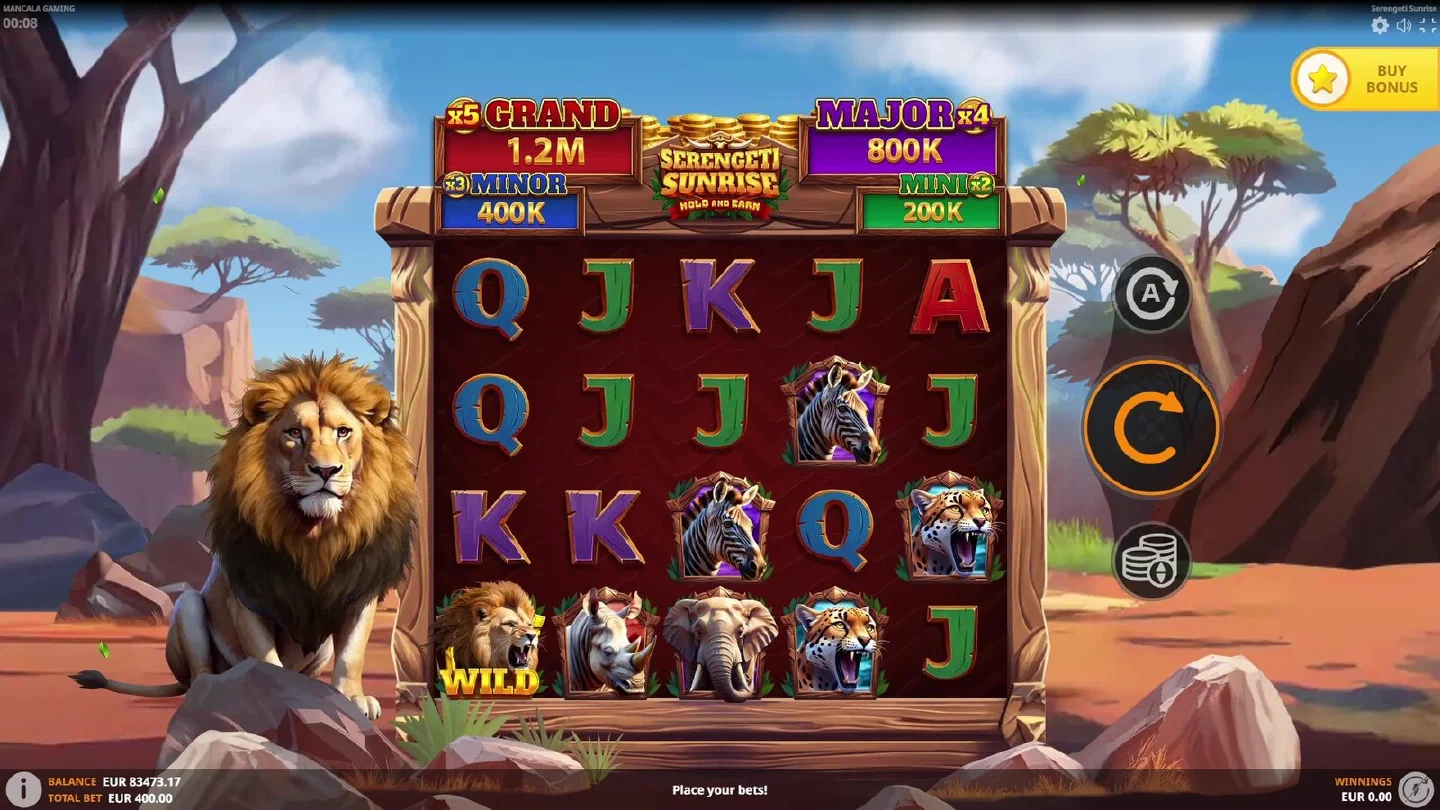
The provider rates volatility high, 4 of 5, and the measured hit frequency is 15.99%. Almost 16 spins in every 100 end with a win. Put those two figures together and the shape of a session is easy to picture: long quiet passages, occasional small returns that slow the bleed, and then one round that either makes the session or does not arrive.
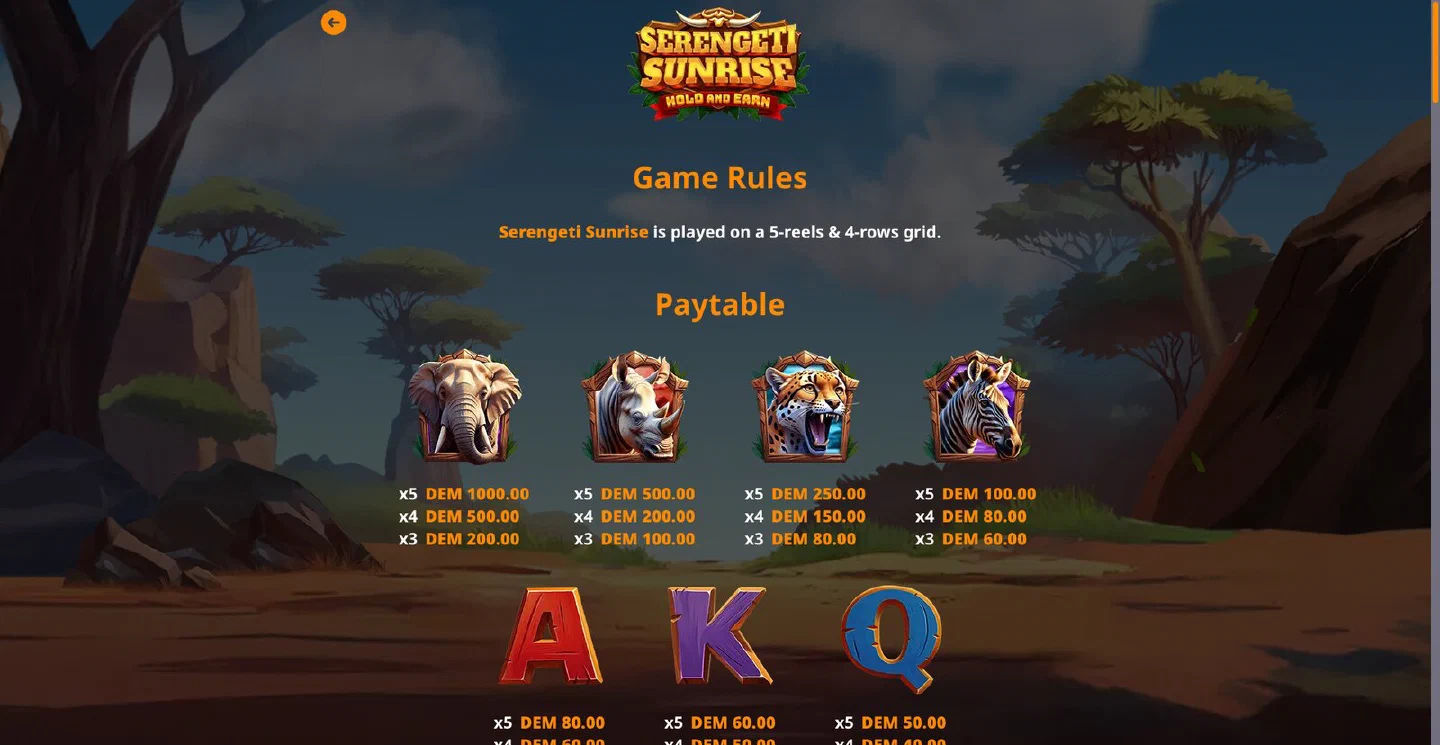
The paytable explains why. All 40 lines pay left to right and only the highest combination on each line counts, so overlapping wins do not stack up. At the bottom of the ladder five jacks return 2x your bet, five queens 2.5x, five kings 3x and five aces 4x. Those are the wins that make up most of the 15.99%, and at a stake of 20 they are worth 40, 50, 60 and 80 credits. None of them changes a session.
The animals are a different proposition: zebra 5x, cheetah 12.5x, rhino 25x, elephant 50x, with the Wild lion matching the elephant. Five elephants at a stake of 20 pay 1,000 credits, which is 50 spins of stake back in one hit. The gap between 2x and 50x across eleven paying symbols is exactly what a 4-of-5 volatility rating describes.
There is a practical consequence. A bankroll that would last two hours on a low volatility slot will not last two hours here at the same stake, because the game holds back value for the respin round. Either drop the stake or shorten the session, and set the autoplay limits accordingly. The strategy page works that out in detail.
The bet range and what each level buys#
The total bet runs from 20 to 1,800 in demo credits, and every casino maps that onto its own scale, which is why every calculation here is in multiples of your bet. The practical spread is 90-fold, and everything scales with it in a straight line: the bonus buy, the jackpots and the ceiling all move together.
| Total bet | Bonus buy at 80x | Mini jackpot at 500x | Grand jackpot at 3,000x |
|---|---|---|---|
| 20 | 1,600 | 10,000 | 60,000 |
| 100 | 8,000 | 50,000 | 300,000 |
| 200 | 16,000 | 100,000 | 600,000 |
| 1,800 | 144,000 | 900,000 | 5,400,000 |
There is one bonus buy option, priced at 80x the total bet. The price being a multiple instead of a fixed sum is useful, because it means the decision is identical at every stake: you are always paying 80 spins’ worth of stake for one entry into the respin round.
Now put that price against the prizes properly, since the ratio is the whole argument for or against buying. The Mini is 500x and the buy is 80x, so the smallest of the four jackpots is worth 6.25 times what the round costs. Against the Minor at 1,000x the buy is one twelfth and a half of the prize; against the Major at 2,000x it is one twenty-fifth; against the Grand at 3,000x it is one thirty-seventh and a half. And against the 5,000x round cap, 80x is one sixty-second and a half. Those five ratios hold at every stake from 20 to 1,800, because every one of the figures is a multiple of the same bet. What they do not tell you is how often a purchased round reaches any of them, which is why the buy is a budgeting decision and not an edge.
Where the buy hurts is the run of misses. Five buys at a stake of 20 cost 8,000 credits, which is 400 spins of base game you did not play. Fix a number before you start and treat it as the session budget, not as a target to chase past.
The 5,000x ceiling and the four jackpots#
| Jackpot | Jackpot symbols | Multiplier |
|---|---|---|
| Mini | 2 | 500x |
| Minor | 3 | 1,000x |
| Major | 4 | 2,000x |
| Grand | 5 | 3,000x |
The rules cap a round at 5,000x the bet, winnings from the Gamble feature included. The Grand jackpot pays 3,000x. Put those two figures side by side and the design gives itself away: the Grand is not the ceiling, it is 60% of the ceiling, and the remaining 2,000x has to come from somewhere else.
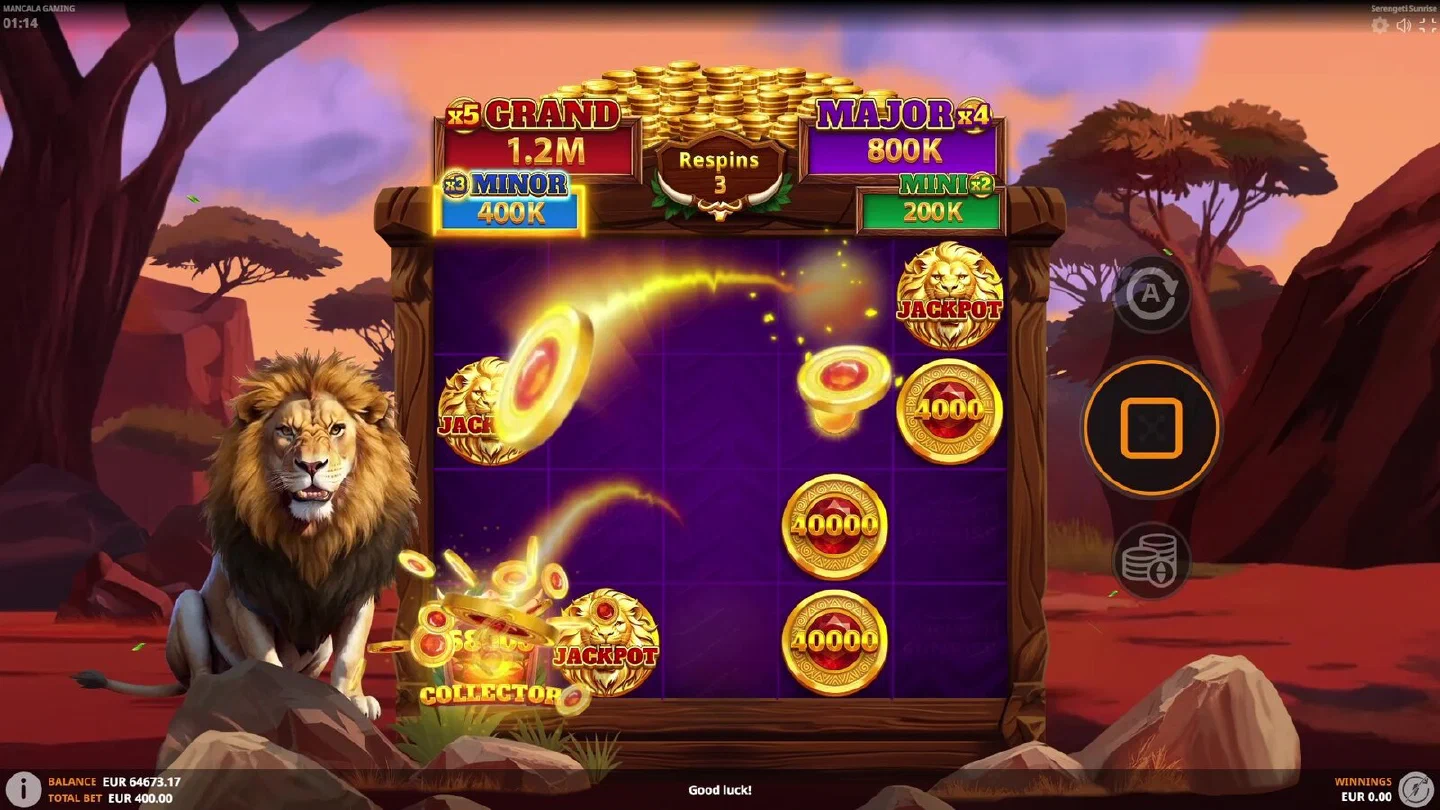
That somewhere else is the special symbols. Their multipliers run 1x, 2x, 3x, 4x, 5x, 10x, 25x, 50x, 75x and 100x, on a base value of 200 credits at a total bet of 20, which is 10x your stake for a standard symbol. A board carrying a 100x, a 75x and a 50x has 225x sitting on it before the collector even fires, and the collector sweeps all of them into one payout while clearing their spaces for new symbols. That recycling is the road to the cap, and a round that fills the reels completely is the version where it becomes plausible.
At a stake of 20 the cap is 100,000 credits; at 200 it is 1,000,000; at the maximum of 1,800 it is 9,000,000. Those are ceilings, not expectations, and most rounds finish far below them. What the numbers do tell you is that the headroom is genuine: 2,000x of a round’s capacity sits above the Grand and belongs entirely to the special symbols and the collector.

The full mechanics of how symbols lock, how the counter resets and what the collector does in each phase are laid out on the features page , and you can watch the whole thing happen on practice credits in the demo .
Worked examples at a stake of 20#
Numbers land better attached to a spin, so here are six, all of them built from the paytable and the bet range, never from guesswork. The stake throughout is a total bet of 20 on the demo scale.
A quiet winning spin. Three jacks pay 20 credits: exactly your stake back. These are common, they make up a large share of the 15.99%, and they are the reason a bankroll lasts long enough to matter.
A decent line hit. Four elephants pay 500 credits, or 25 spins of stake in one go. On a 40-line grid with a lion that lands stacked four high, this is the kind of result that funds the waiting.
The best base-game line. Five elephants or five wild lions return 1,000 credits, which is 50x the bet. That is the top of the regular paytable, and it is worth holding in mind because a single 100x special symbol, at 2,000 credits, is worth twice as much.
A modest respin round. Six standard special symbols at 200 credits each come to 1,200 before anything else happens: 60x the stake, from a round that has not yet used a respin.
A jackpot round. The Mini at 500x pays 10,000, the Minor at 1,000x pays 20,000, the Major at 2,000x pays 40,000 and the Grand at 3,000x pays 60,000. The round cap of 5,000x sits at 100,000, which leaves 40,000 of room above even a Grand.
A purchased round. The buy costs 1,600 credits at this stake. Break even on it and you need the round to return 80x, which is eight standard special symbols at 200 credits each, or a single 75x symbol plus one standard one. Land the Mini and the round returns 10,000 against the 1,600 you paid. Land nothing beyond three empty respins and the whole 1,600 goes with them. Both of those are normal outcomes of the same purchase, and the gap between them is what a 4-of-5 volatility rating means when you spend rather than spin.
Multiply every figure above by five for a stake of 100, by ten for 200, or by 90 for the maximum of 1,800. Nothing about the structure changes; only the scale does, which is the practical benefit of a game that prices everything in multiples of the bet.
Reading these numbers honestly#
The return is a property of the game, not a forecast for your session. Ninety-five per cent is measured across a population of rounds so large that no individual player ever sees it, and a 15.99% hit rate means variance dominates anything you will personally experience. The certified random number generator behind every spin means the outcome cannot be influenced or predicted from your side, and any page that suggests otherwise is selling you something.
What you can control is the session, and the settings menu hands you the tools for it before the first spin: a cap on how many rounds run, a floor under how far the balance may fall, and a line above which the run stops on its own. Set all three in advance and treat the losing side as the real decision. Pick the stake from the 20 to 1,800 range that lets you take the quiet passages without flinching, because those passages are the price of a 500x jackpot that needs only two symbols.
Compare the figures against another savanna release on the head-to-head page , and the rest of the game is covered from the Serengeti Sunrise hub .
18+. The 95% is a property of the game across millions of rounds and never a forecast for your session. Set your limit first: here is the responsible gambling page .